
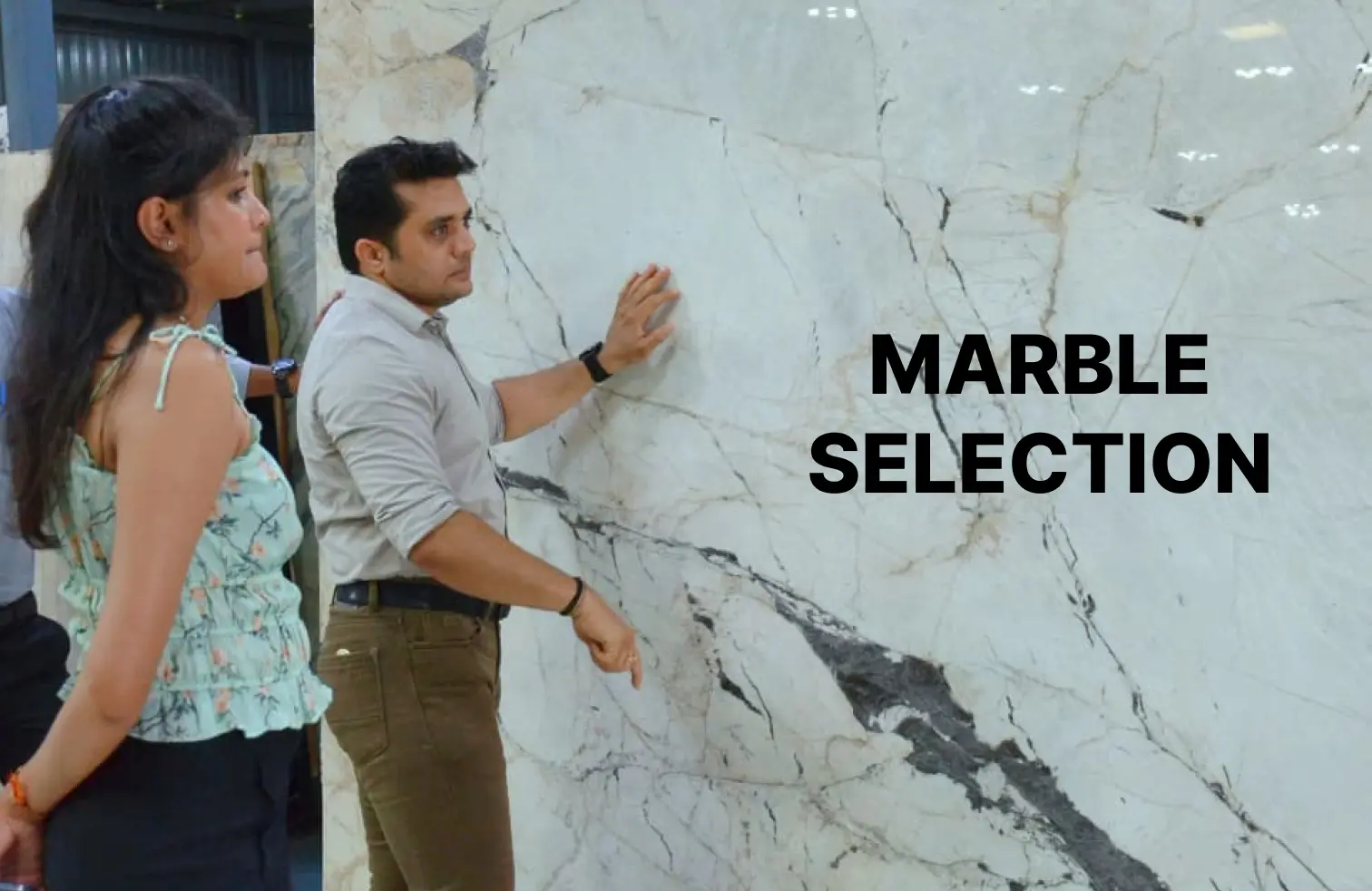
There’s a moment in most high-end projects when the material selection stops being a technical decision and becomes something closer to an editorial one. Italian marble is usually at the center of that moment.
Architects who work regularly with natural stone will tell you the process looks nothing like what clients imagine. It’s not a catalog browse or a finished sample pinned to a mood board. It’s tactile, time-consuming, and deeply tied to the specific story a space is trying to tell.
It starts with the space, not the stone
Before any slab gets shortlisted, the design narrative has to be settled. Is this a space that should feel quiet and seamless, where the marble disappears into the architecture? Or is the stone meant to be the room’s defining gesture — something guests stop and look at?
That distinction drives everything else. Uniform, low-movement marbles like certain Calacattas or Sivec whites tend to disappear beautifully into minimal interiors. The more dramatic varieties — heavy veining, strong tonal contrast — are better suited to moments: a lobby wall, a statement island, the back of a fireplace. Using a dramatic stone throughout a space often collapses the drama entirely.
Variety selection is more technical than it looks
Once the intent is clear, the shortlisting begins. And this is where architects get specific in ways that suppliers appreciate and clients rarely see.
Veining behavior matters enormously. A marble with consistent, directional veins can be planned around — you can anticipate how it’ll read across a large floor, how it’ll behave when cut and re-joined. Stones with random, chaotic movement are harder to control at scale. That’s not a reason to avoid them, but it changes how you specify them and how much material you need to account for waste and matching.
Base tone is another consideration that gets underestimated. Warm-white marbles read very differently from cool-white ones under the same lighting. On paper, two slabs might both be “white marble.” On site, under the specific light conditions of a particular room, they can look like entirely different materials.

Slab selection is where it either works or doesn’t
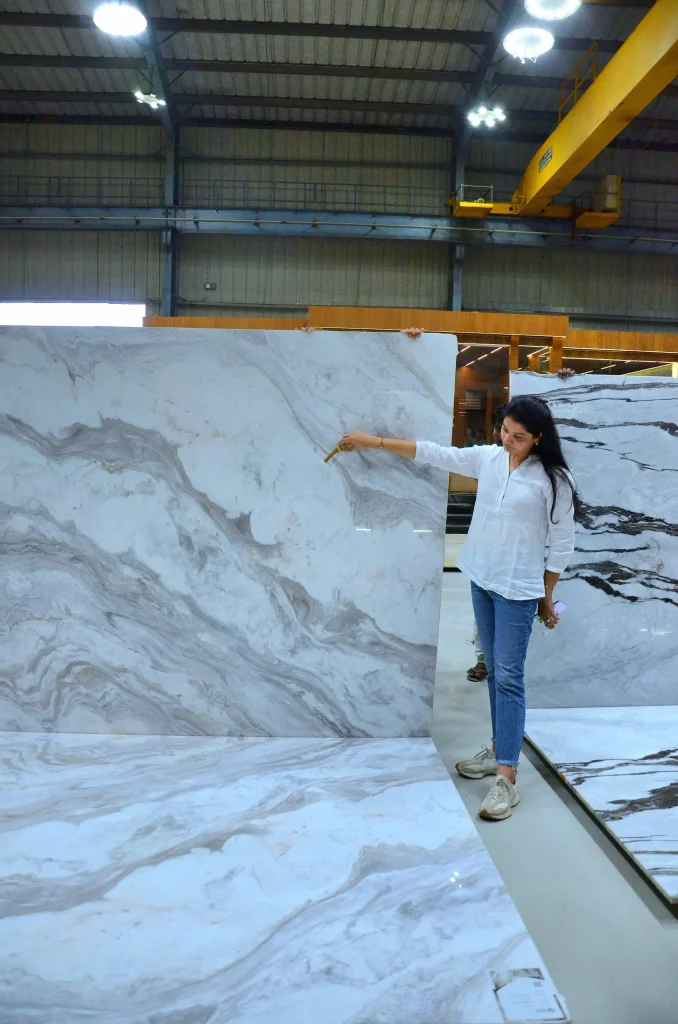
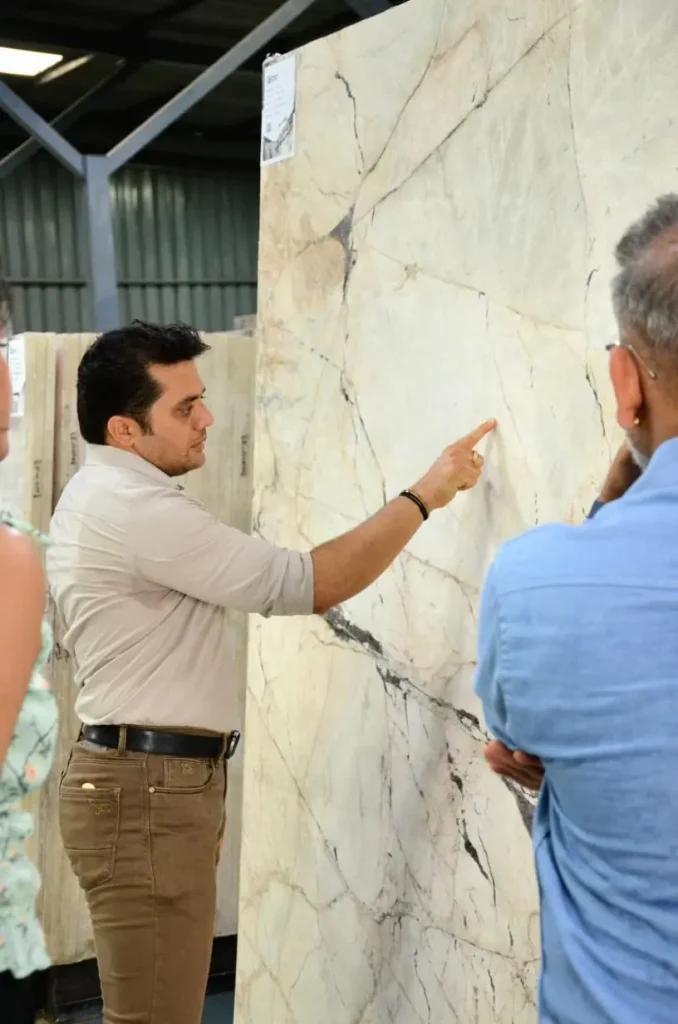
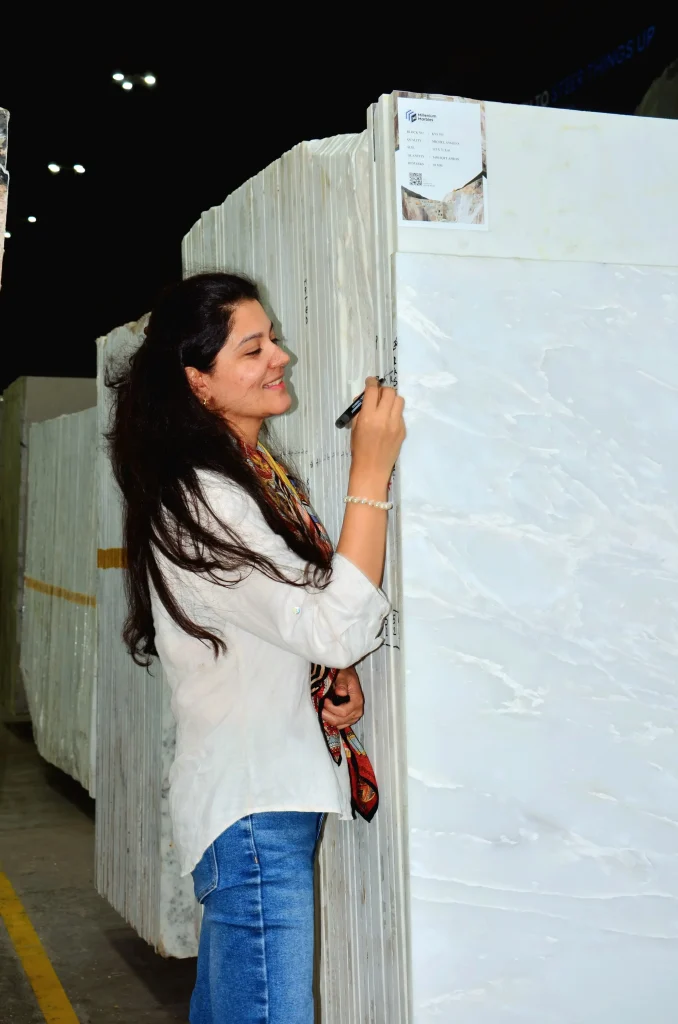
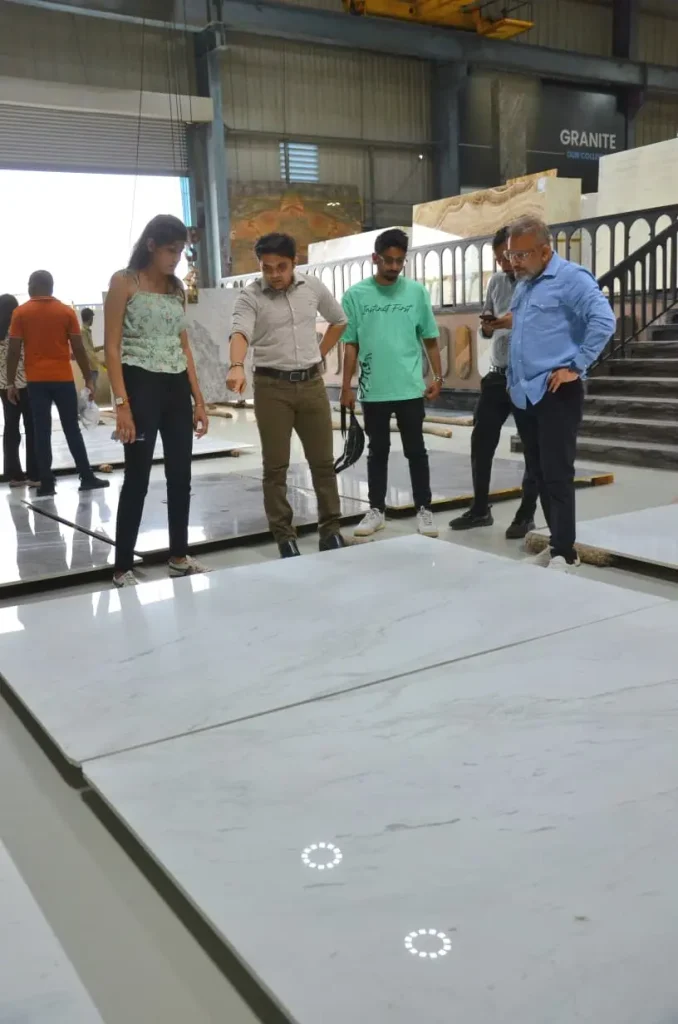
The single biggest separator between a standard project and a genuinely exceptional one is whether the architect physically selected the slabs. Not approved them from photographs. Not signed off on a specification sheet. Actually stood in a warehouse and looked at them.
No two slabs from the same quarry are identical. Even slabs from the same block will have variation — in tone, in the density of veining, in the way the surface catches light. Photographs compress that variation almost completely. You cannot see a slab properly until you’re standing in front of it, ideally in natural light.
For large-format applications — floor fields, full-height wall cladding — architects will often reserve a run of slabs from a single block. This keeps the tonal range tight and makes the space feel considered rather than assembled. On projects with bookmatched features, this isn’t optional; it’s the only way the detail works.
Bookmatching and layout planning
Bookmatching — mirroring adjacent slabs so their veins form a symmetrical pattern — is one of the most dramatic tools in a stone designer’s toolkit. When it works, it’s extraordinary. When it’s underplanned, it looks accidental.
Getting it right requires layout drawings that account for vein direction, slab dimensions, and the exact positioning of cuts. It’s the kind of detail that gets resolved long before fabrication begins, because course-correcting it during installation is expensive and sometimes impossible. Architects who do this well tend to treat the slab layout as a design drawing in its own right, not a trade coordination document.
Performance matters as much as appearance
Marble is a relatively soft stone, and some varieties are softer than others. A marble that photographs beautifully might be poorly suited for a high-traffic floor, a heavily-used countertop, or a bathroom surface that sees daily water exposure.
Natural fissures — thin fractures within the stone that are part of its geology, not defects — require attention. Some fissures are stable and purely cosmetic. Others run through structurally significant areas of a cut and need to be filled or reinforced. Thin-format slabs often require fibre backing to maintain integrity through fabrication and installation.
None of this means avoiding complex stones. It means specifying them correctly and being honest with clients about maintenance expectations upfront.
Finish isn’t a cosmetic decision
Polished marble is the default assumption, but it’s not always the right call. A high-gloss finish amplifies the stone’s depth and color, which works beautifully in formal rooms with controlled lighting. It also shows every fingerprint and scratch in spaces that see real use.
Honed finishes — matte, slightly absorbent — are more forgiving in terms of surface marks, and they tend to give stone a quieter, more contemporary presence. Leathered and brushed finishes have become more common in recent years; they add a tactile quality that reads as deliberately considered rather than simply luxurious.
The choice should reflect how the space will actually be used, not just how it’ll photograph.
Execution is half the result
A well-selected marble can be ruined by poor fabrication or installation. The tolerances involved in high-end stone work are tight — joint widths, vein alignment across cuts, consistent surface leveling. These things require fabricators who’ve done it before and installation teams who understand what they’re looking at.
Architects on premium projects tend to stay closely involved through the execution phase, not because they don’t trust the trades, but because stone is unforgiving. A miscut can’t be undone. An alignment decision made in the field without design input often doesn’t hold up.

Budget strategy in stone selection
Even substantial project budgets have limits, and experienced architects know where stone delivers the most value and where it doesn’t.
The general approach is concentration: use premium stone where it’ll be seen, touched, and remembered — an entry floor, a bathroom feature wall, a kitchen surface — and make different choices in secondary areas where the material cost doesn’t translate proportionally into perceived quality. The goal is a project that feels consistently excellent, not one where the budget spent on one room undermines everything else.
The supplier relationship
This part gets underemphasized in most writing about marble selection, but the supplier relationship genuinely shapes what’s possible. Architects who work with the same suppliers across multiple projects develop a shorthand — the supplier understands the quality threshold, knows how to communicate when something doesn’t meet spec, and can anticipate what the project needs before it’s fully articulated.
A good stone supplier isn’t a vendor. They’re part of the design process from slab selection through to delivery, and the ones worth working with know that.
Italian marble rewards the level of attention most architects are already inclined to give it. The decisions aren’t complicated in principle — they’re just specific, numerous, and consequential. Approach them that way, and the material tends to do exactly what it’s supposed to do: anchor a space and make it feel like it could only be itself.
Planning a Premium Project?
If you’re exploring Italian marble for your next project, it’s always advisable to:
- View slabs in person
- Work with experienced suppliers
- Align material selection with design goals
The right choice can elevate a project from good to exceptional.