
Walk into almost any well-built Indian home — a sprawling bungalow in Ahmedabad, a sea-facing apartment in Mumbai, a haveli that’s been in the family for three generations — and there’s a reasonable chance the floor underfoot is marble. That’s not nostalgia. It’s a material that genuinely suits the way we live here: the heat, the foot traffic, the preference for spaces that feel clean and open. Marble delivers on all of that, which is why it keeps getting specified even as newer materials come and go.
The harder question isn’t whether to use marble. It’s which one?
And the honest answer is that there isn’t a single “best” marble for Indian homes. There’s the best marble for your budget, your specific rooms, your tolerance for maintenance, and the kind of look you’re going for. Those are four different questions, and conflating them is where most people run into trouble.
Here’s what I’ve seen work, and what hasn’t.
The Indian vs. The Italian question is the wrong starting point
Most people walk into a marble showroom already thinking about this divide — Indian marble on one side, Italian on the other, with Italian carrying the prestige and Indian carrying the “practical choice” reputation. That framing isn’t wrong exactly, but it leads people to make decisions for the wrong reasons.
I’ve seen homes where someone spent a significant portion of their flooring budget on Italian marble throughout the house — corridors, bedrooms, kitchen, the works — and within two years the floors looked tired. Not because the stone was bad. Because Italian marble in a high-traffic Indian home, without obsessive maintenance, doesn’t hold up the way people expect it to.
And I’ve seen homes with Makrana white throughout that looked immaculate fifteen years in. Better, actually, than when they were first laid — the stone had developed a patina that only comes with age and use.
So before the Indian vs. Italian question, please ask: What is this floor actually going to go through?
What Indian marble actually is — and why it gets undersold
Rajasthan produces some of the finest marble in the world. That’s not nationalism, it’s geology. The stone quarried around Makrana, Ambaji, Dungri, and Kishangarh — these are hard, dense, high-quality materials that have been used in serious architecture for hundreds of years.
Makrana specifically is denser than most Italian marble. It’s harder. It resists scratching better. It handles wet mopping, which is how most Indian homes get cleaned daily, without the surface degrading the way softer stones do. And it quarries in large, consistent blocks, which means you can get uniform slabs for big floor areas without the kind of variation that creates headaches during installation.
The reason it gets undersold is partly aesthetics — the veining is subtler, the look is quieter — and partly because Italian marble has better marketing. But for a home where the floors will actually be lived on, Indian marble is frequently the smarter call.
Where Italian marble genuinely makes sense
That said, there’s a reason Statuario and Calacatta command the prices they do, and it’s not entirely marketing.
The movement in good Italian marble — the way the veining flows, the depth you see in the surface under light — is something Indian varieties mostly don’t replicate. In a formal living room with good natural light, a well-selected slab of Statuario does something to the space that’s hard to achieve with other materials. It looks expensive because it is, but also because it genuinely has a visual quality that’s its own thing.
The catch is that this visual quality comes with conditions. Italian marble is softer. It scratches more easily. It’s more porous, so it stains if you don’t seal it and maintain the sealant. In a kitchen, even a small amount of turmeric or oil left to sit will leave a mark. In a corridor where shoes go on and off all day, you’ll see the surface start to dull within a few years.
So Italian marble makes sense in spaces that are more seen than used — the formal living room that doesn’t see children running through it, the master bedroom, maybe a powder room where guests go. It does not make sense in the kitchen, the kids’ rooms, the back corridor, or anywhere the floor takes a daily beating.
Room by room, practically speaking
Living room — this is where most people want to make a statement, and it’s the right place to do it. If you’re going to use Italian marble anywhere, use it here. Go for larger slabs if your budget allows; the fewer joints on a floor, the better it looks. Pay attention to veining direction when the slabs are being laid — it matters more than people realize.
Bedrooms — honestly, Indian marble is perfectly good here and often better. You want something that feels comfortable underfoot in the morning, not something that requires you to think about spilling your morning chai. Softer tones, lighter stones, nothing too dramatic.
Kitchen — don’t use marble in the kitchen unless you are genuinely prepared to maintain it. If you insist, use a hard Indian variety with a honed finish and seal it every year without fail. But granite is a better material for this space. It’s not as beautiful, but it’s honest about what it is.
Bathrooms — the finish matters more than which stone you choose. Polished marble in a wet bathroom is slippery and shows every water mark. Honed finish is safer, easier to clean, and looks more considered anyway. Both Indian and Italian marble work fine here.
Staircases and corridors — use your hardest Indian marble here, full stop. These surfaces get more wear than anything else in the house. Nobody has ever stood at the bottom of a staircase and said “I wish we’d used Italian marble.” They have absolutely stood there and noticed that the stairs look worn and scuffed.
The finish thing, which everyone ignores until it’s too late
People spend weeks choosing which marble to use and about four minutes thinking about the finish. This is backwards.
A polished floor is reflective, glossy, and looks spectacular in photographs and on the day it’s laid. It also shows every scratch, every footprint, every spot where the surface has dulled from foot traffic. If you have a cleaning person who uses a mop with any grit in it, you will see the results within months.
A honed floor — matte surface, no reflectivity — is more forgiving. It doesn’t dull because it wasn’t shiny to begin with. It shows fewer marks, handles daily cleaning better, and tends to age more gracefully. A lot of people see a honed floor and think it looks understated. They’re right, and after five years of living with it, they’re also grateful.
There’s no objectively correct answer here, but if you’re laying marble in an area that sees real daily use, think seriously about honed before defaulting to polished.
The combination that actually works
The homes that get marble flooring right are almost never the ones that use one material throughout. The ones that look good and hold up well tend to have a deliberate logic: Italian marble where it’ll be seen and appreciated, Indian marble where the floor needs to perform, something else entirely in the kitchen.
It sounds like a compromise. It isn’t. It’s just treating each room as its own problem with its own right answer, instead of trying to find one solution that works everywhere — which, with marble, doesn’t really exist.
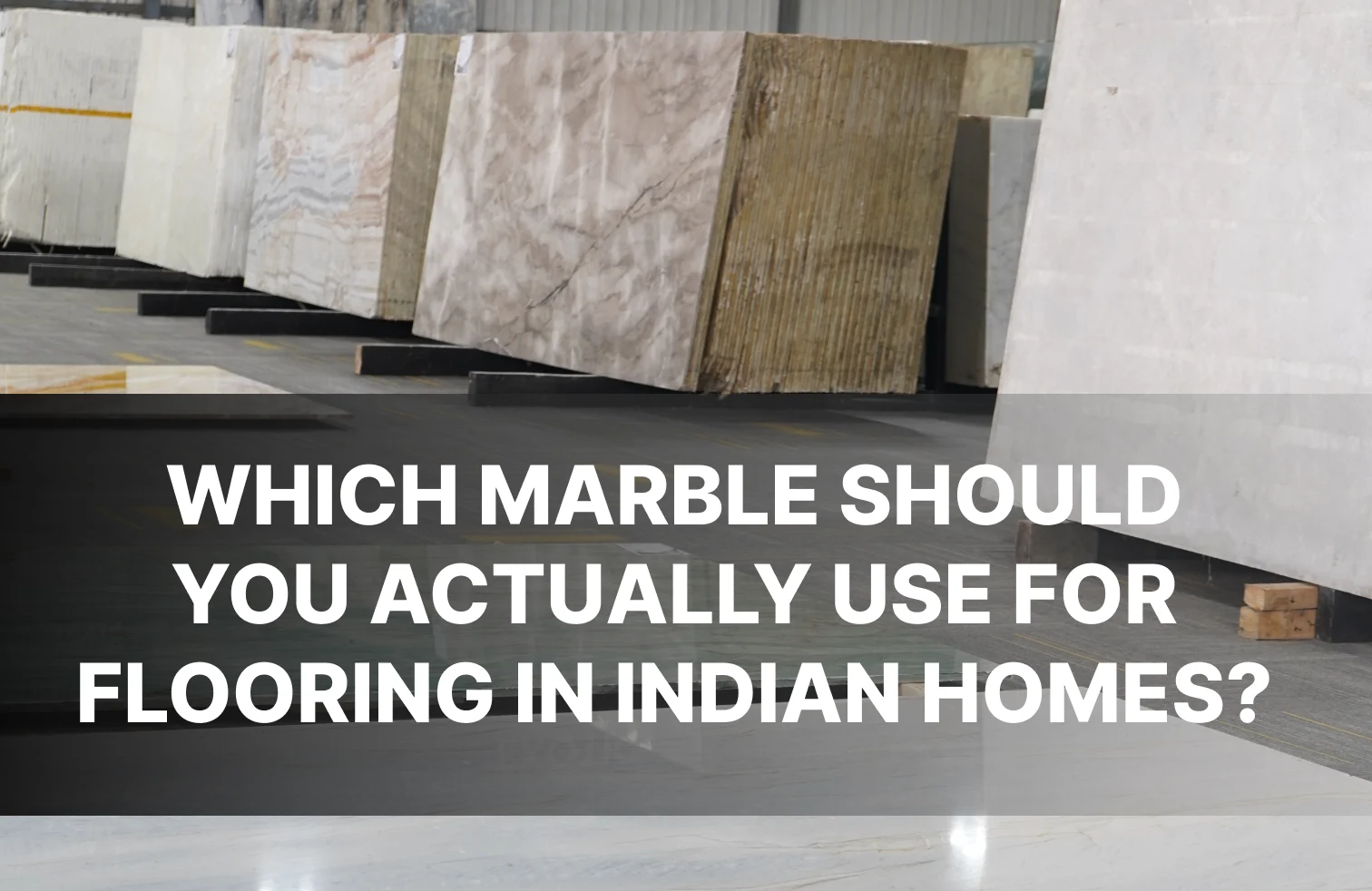
One last thing: go see the slabs in person before you commit to anything. Photographs of marble are essentially useless for making real decisions. The colour is different, the movement is different, and the way it responds to light is completely lost. If a supplier won’t let you visit and select slabs yourself, find a different supplier.